Restore damaged or missing teeth with customized dental crowns and bridges at RNC Dental for improved function, strength, and a natural-looking smile.
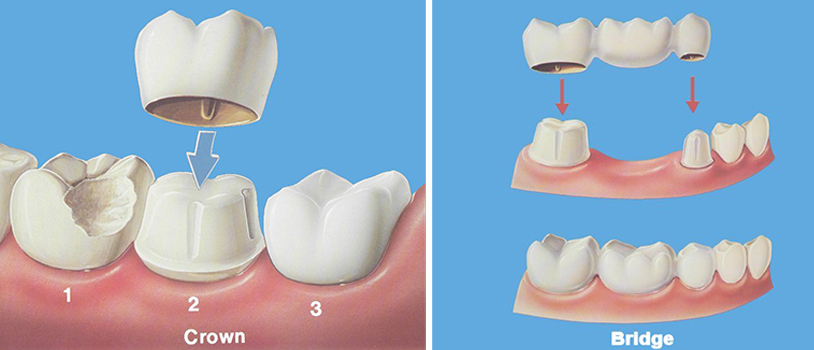
Dental crowns and bridges are commonly used restorative dental treatments to repair damaged teeth, restore the appearance and function of teeth, and replace missing teeth. They can help improve chewing, protect weakened teeth, restore your smile, and support better overall oral function.
At RNC Dental, Gurgaon, our dental team provides personalized dental crowns and bridges treatment based on your tooth condition, oral health, aesthetic requirements, and individual needs.
A dental crown, also known as a tooth crown, is a custom-made dental restoration that covers a damaged or weakened tooth. It can restore the tooth’s shape, strength, size, and appearance while providing protection against further damage.
Dental crowns may also be placed over dental implants to replace a missing tooth. Depending on your dental needs, crowns can be made from materials such as porcelain, ceramic, metal, or other tooth-colored materials.
Your dentist may recommend a dental crown in the following situations:
Getting a dental crown generally involves the following steps:
Your dentist examines the tooth and surrounding gums to determine whether a crown is suitable. The damaged or decayed portion is treated, and the tooth is carefully prepared to create space for the crown.
An impression or digital scan of the prepared tooth and surrounding teeth is taken. This helps create a crown that fits properly and matches your bite and smile.
A temporary crown may be placed to protect the prepared tooth while the permanent crown is being fabricated.
The permanent crown is custom-made according to the required size, shape, color, and fit.
Once the permanent crown is ready, your dentist checks its fit, shape, bite, and appearance. After any necessary adjustments, the crown is securely placed on the tooth.
A dental bridge is a fixed dental restoration used to replace one or more missing teeth. It consists of one or more artificial teeth that fill the gap and are supported by natural teeth or dental implants, depending on the type of bridge.
Dental bridges can help restore your ability to chew and speak while also improving the appearance of your smile.
Traditional bridges are one of the most commonly used types. They use dental crowns placed on the supporting teeth on either side of the missing tooth or teeth.
A cantilever bridge is supported by a tooth on only one side of the missing tooth. It may be considered in selected situations depending on the location and condition of the supporting tooth.
Maryland bridges use a framework that is bonded to the back surfaces of the adjacent teeth. They can be suitable for selected cases, particularly when replacing certain front teeth.
Implant-supported bridges are supported by dental implants rather than natural teeth. They may be used when multiple adjacent teeth are missing and can provide a stable fixed replacement option.
The dental bridge procedure may involve the following steps:
Your dentist examines the missing tooth area and the teeth or implants that will support the bridge. If natural teeth are being used as support, they may be prepared to accommodate the crowns.
An impression or digital scan is taken to design a bridge that fits comfortably with your existing teeth and bite.
A temporary bridge may be placed to protect the prepared teeth and maintain the appearance and function of your smile while the permanent bridge is being made.
The permanent bridge is custom-made according to your dental requirements, including the size, shape, shade, and position of the replacement teeth.
Once the bridge is ready, your dentist checks its fit and bite before securely placing it. Any required adjustments are made to ensure comfort and proper function.
Dental crowns and bridges can provide several benefits, including:
Proper care is important for maintaining the health and longevity of your crowns and bridges.
If you have a damaged, weakened, or missing tooth, dental crowns and bridges in Gurgaon can help restore your smile and oral function.
At RNC Dental, our dental team evaluates your teeth and overall oral health before recommending the most appropriate restorative treatment. Whether you need a crown to protect a damaged tooth or a bridge to replace missing teeth, your treatment is planned according to your individual dental needs.
We always take care of your smile
(+91) 9871701802
Experience the future of dentistry with us—where innovation meets excellence for your perfect smile!
Address:- OFFICE SPACE 5, Sixth Floor, Block 1, M3M URBANA, &, Golf Course Extension Road, Ramgarh, Sector 67, Gurugram, Haryana 122102
Copyright © 2025 All Rights Reserved.